Showing posts with label Libraries. Show all posts

1/19/2019

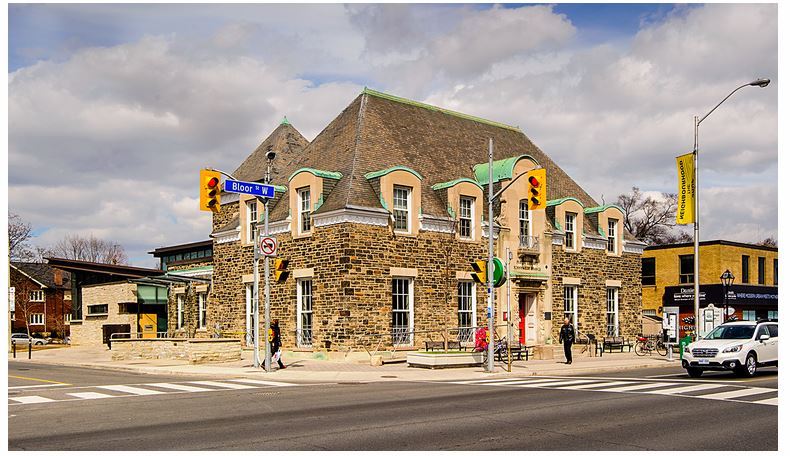
The Runnymede Library

Located at 2178 Bloor Street West, near High Park; this branch is nationally recognized for its distinctive Canadian style of architecture.


It was designed by John M. Lyle in 1929 and is dominated by a steeply pitched slate roof with bell-cast eaves.
The walls are made of variegated red and yellow Credit Valley limestone. 
The doorway is framed with totem poles of stylized ravens, beavers and bears.


The aboriginal theme continues in the building's ironwork, which includes inverted triangle and arrowhead patterns. 
Other Canadian motifs highlighted in the stonework are lilies, pinecones, plus keystones of squirrels and native Indian heads.

As part of  Heritage Toronto's Plaques and markers program, an unveiling of a plaque took place in June of 2008.


According to this plaque, the branch was featured on a postage stamp celebrating Canadian architecture in 1989.


Like most libraries, these days, this one has had a couple of renovations done in order to modernize and enlarge the space.
It was renovated first in 1978, and then again in 2004. 
Thankfully, the architect's original building was carefully restored.


1/30/2016

The York Mechanic's Institute

At the North-East corner of Church and Adelaide Streets sits a heritage plaque:


This was not a former automobile garage, nor was it a training facility for mechanics. It was more a place for teaching new methods of manufacturing and craftsmanship.
It sponsored lectures, held classes and operated a lending library.
This was one of the many steps that eventually led to the present Toronto Library System.
It wasn't until the early 1900's that borrowers were allowed to retrieve books for themselves, instead of asking the staff.
Over the years, the City received enough money from Andrew Carnegie to build ten libraries.
As well, the Library has been the recipient of a number of private collections from a few philanthropists.
One such gift was over 4,000 pictures and pictorial material from John Ross Robertson. This Toronto resident was the founder of the Toronto Telegram, and a fervent advocate of amateur hockey. There is a plaque in front of his home on Sherbourne Street and there is a Public School named after him.
Another donation came from a British librarian back in 1934 (the Osborne Collection of Early Children's Books). As well, the is a Science Fiction and Fantasy Collection housed on the second floor of the Lillian H. Smith Library. This collection was donated by Judith Merrill, a fiction writer herself. It is a non-circulating research collection of over 72,000 items.
Her life story is something that I should blog about in the near future.
While the world was celebrating the arrival of the Millennium, the Toronto Public Library received a grant from the Bill and Melinda Gates Foundation. This allowed the library to purchase 400 internet workstations.
On going sponsor-ships from companies such as the Toronto Star and Toronto Dominion Bank, have allowed the Toronto Reference Library to display some of their collections.

11/23/2011

Lillian H. Smith Library

The other day, I attended a "Memoir Writing" session at the Lillian H Smith Library.
This unique structure was designed by Architect Phillip H. Carter, and has been described as one of Toronto's most "happily eccentric buildings".
The huge arched entrance way is guarded by a winged lion and griffin.
It almost gives you a feeling of a medieval castle.


As you can see from the picture below, the building is square on the outside.....


..............but it is circular on the inside.


There is a curved staircase with torches lighting your way down to the meeting rooms in the basement.


Aside from the architecture, this library is home to The Merril Collection of Science Fiction, Speculation and Fantasy, as well The Osborne Collection of Early Children's Books.

The library was named after Lillian Helena Smith, a children's librarian, who, among other things, introduced a new classification designed to organize books in a way more suited to children's collections.

Blog Archive