12/02/2007

The Glasgow Subway is an underground metro system in Scotland.

It opened on 14th of December 1896, it is the third oldest subway system in the world after the London Underground and the Budapest Metro.

It was unique in being the only cable-operated underground railway in the world.


Pictured here, are the directors, engineers, and officials of the original Glasgow District Subway circa 1896.


Most station entrances were buried in store-front locations: if you didn't know the subway entrance was there, you might take a long time finding it.

This station was the exception.


The cable system was characterized by a number of unusual features. There were two cables, driven by steam from a main power station, one for each tunnel. Each cable was an inch and a half thick, and weighed about 57 tons. The cables were placed between the tracks, kept in motion during the whole of the time that the line was open to traffic, and ran at a uniform speed of twelve and a half miles an hour.


Originally a cable railway this Subway was later electrified, but its twin circular lines were never expanded.
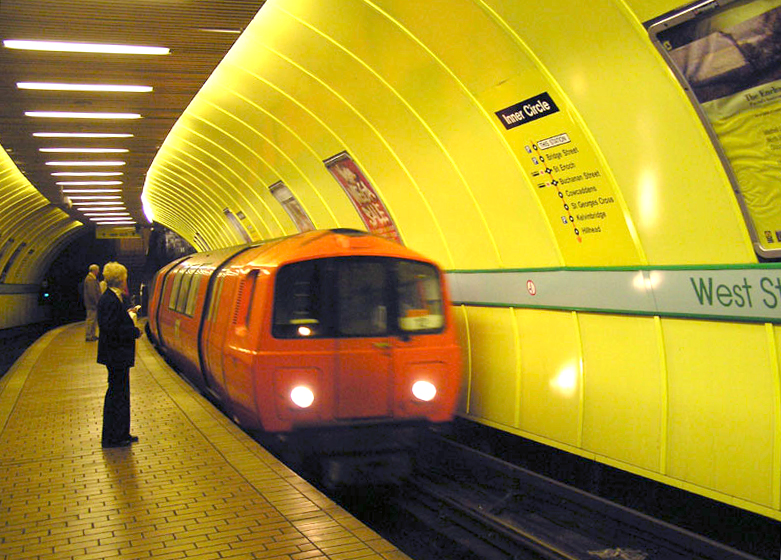


Officially called the Glasgow Underground between 1936 and 2003, it has reverted to its colloquial name of Subway.

Here in London England we find the world's oldest underground system, and one of the longest in terms of route length.

Services began on January 10, 1863 on the Metropolitan Railway; most of the initial route is now part of the Hammersmith City line.


Despite its name, about 55% of the network is above ground.
Popular local names include the Underground and, more colloquially, the Tube (in reference to the cylindrical shape of the system's deep-bore tunnels).


The Underground has 275 stations and runs over 253 miles (408 km) of line.
There are also numerous closed stations.


This is the City Road station, and is relatively inconspicuous from the surface: the only suggestion that a station ever existed is a brick ventilation shaft that incorporates parts of the original station building.

This is Paris: The City of Lights.


The Paris Métro (French: Métro de Paris) has 16 lines, primarily underground, with a total route length of 213 km (133 miles).


There are 298 stations (245 of which are within the 41 square miles of the city – the densest provision of subway stations in the world).


This is Line Five crossing the Seine on the Austerlitz viaduct.


On July 10, 1900 the first line of the network, known as Maillot-Vincennes was inaugurated during the Paris World's Fair.

The system was expanded quickly at the outbreak of WW1 and the core of the Métro network was completed by the 1920s.

In the 1960s, the opted solution was finally to revive a project which had been abandoned at the end of the 19th century: joining suburban lines to fully new underground portions in the city centre. The proposed regional metro system would be known as the réseau express régional (regional express network) (RER).

Located in almost the centre of Spain, is Madrid, the capital

The city has preserved the look and feel of its historic neighbourhoods and streets.


The Madrid Metro is one of the largest metro systems in the world, which is especially remarkable considering Madrid's population is approximately 3.5 million.

The first line of the Madrid metro opened on October 17, 1919 under the direction of the Compañía de Metro Alfonso XIII, with 8 stations and 3.5 km. of track.


When the trains come into this station, the mural moves, and show an animated train rolling across the wall.


Stations in the Madrid metro reveal their age in their design: older stations on the narrow lines are often quite compact, rather like the stations on the Paris Metro. They were decorated with tilings in different colour schemes depending on the station.

This is a photo of the original decorations in the Bilbao Station.


In Portugal we find the first subway - the Lisbon Metro (Lisboa Metropolitano).


Lisbon's underground stations have the most vibrant and most exciting expressions.

This began in 1957 when Maria Keil was given the task of designing large wall panels for stations. These tiles are referred to as azulejos.


Below we see the Gare do Oriente (Orient Station).

Its glass and steel columns are reminiscent of palms, making the whole structure fascinating to look at (especially in sunlight or when illuminated at night).


Lisbon is known as the ’White city’, a romantic name given to it due to the amount of light shining throughout it.


Blog Archive